
 Bhatter College, Dantan came into being in 1963 as an act of collective imagination and civic resolve—an answer to the long-felt need for higher education in a region shaped by historical discontinuities and educational deprivation. Founded in the early decades of post-Independence India through the philanthropic foresight of Sri Mathuranath Bhatter and the pioneering leadership of Smt. Abha Maity, the founding President of the Governing Body, envisioned the institution not merely as a college, but as a catalyst for intellectual renewal and social mobility. From its modest beginnings, Bhatter College has steadily evolved into a centre of academic credibility and public trust, serving generations of learners from Dantan and its adjoining regions.
The institution stands within the cultural geography of Dandabhukti, a region that flourished between the 6th and 12th centuries CE as a vital corridor of trade, pilgrimage, and intellectual exchange connecting Bengal with Odisha and South India. Archaeological and textual evidences reveal the presence of Buddhist and Brahminical centres of learning where scholarship was integrative rather than insular, dialogic rather than doctrinal. This syncretic intellectual spirit—once reflected in the writings of scholars such as Vasukalpa, whose work exemplified openness across traditions—continues to inform the academic ethos of the college.
Across successive decades, Bhatter College has demonstrated steady academic consolidation and institutional maturity. The NAAC accreditation of Grade ‘B+’ in 2007 marked a formal recognition of quality, followed by UGC recognition in 2009 as a College with Potential for Excellence. A decisive milestone was reached in 2015, when the institution was awarded NAAC Grade ‘A’, an achievement reaffirmed during the Third Cycle of Accreditation in 2023, once again securing Grade ‘A’. These distinctions are especially meaningful given the socio-economic constraints of the region and stand as a testament to the perseverance of our students and the enduring commitment of our faculty.
The conferment of Autonomous Status in 2024 represents a defining phase in the institutional trajectory of Bhatter College. Autonomy has endowed the institution with greater academic discretion—enabling flexible curriculum design, independent evaluation mechanisms, pedagogical innovation, and a strengthened research orientation responsive to contemporary needs. Yet such recognition also carries a deeper obligation: to preserve the standards that merited autonomy, to sustain quality with vigilance, and to advance the institution through responsible governance, academic rigour, and collective accountability.
In consonance with the National Education Policy (NEP) 2020, Bhatter College has re-envisioned its teaching–learning ecosystem to foster holistic, multidisciplinary, and skill-integrated education. Curricula are shaped by experiential learning, outcome-based pedagogy, critical inquiry, and digital competence, supported through blended learning models, ICT-enabled instruction, continuous formative assessment, mentoring frameworks, and learner-centred pedagogical practices. These reforms seek to prepare students not only for professional competence but for thoughtful participation in a complex and changing world.
Anchoring the institutional conscience of Bhatter College is its guiding motto—सत्यम् ज्ञानम् अनन्तम् (Truth as our foundation, Knowledge as our pursuit, Infinity as our horizon—a triad that articulates an enduring academic philosophy. Satyam affirms an uncompromising commitment to intellectual honesty and ethical conduct; Jñānam signifies disciplined inquiry pursued with rigour, humility, and depth; Anantam gestures towards intellectual openness—the recognition that learning is never finite, and that education must remain receptive to new questions, new contexts, and new horizons. This vision resonates with the timeless wisdom of the Bṛhadāraṇyaka Upaniṣad, which invokes:
असतो मा सद्गमय |
तमसो मा ज्योतिर्गमय |
मृत्योर्मा अमृतं गमय ||
Lead us from untruth to truth,
from darkness to illumination,
from limitation to enduring insight.
Embedded within this invocation is the very spirit of the institution: education as movement—away from ignorance and inertia, and towards clarity, discernment, and responsible freedom.
While firmly anchored in regional history and indigenous knowledge traditions, Bhatter College remains attentive to broader global concerns such as sustainability, equity, and responsible institutional governance—values that resonate with international educational frameworks, including the United Nations Sustainable Development Goals, without eclipsing local realities and community imperatives.
Sustained by a culture of academic seriousness, reflective inquiry, and humane values, and enriched by its natural surroundings, Bhatter College continues to offer an environment where intellectual growth is inseparable from ethical formation and social responsibility.
As Dr A. P. J. Abdul Kalam reminded us, “Excellence is a continuous process, not an accident.”
What ultimately defines an institution is not the honours it receives, but the integrity with which it carries them forward into the future.
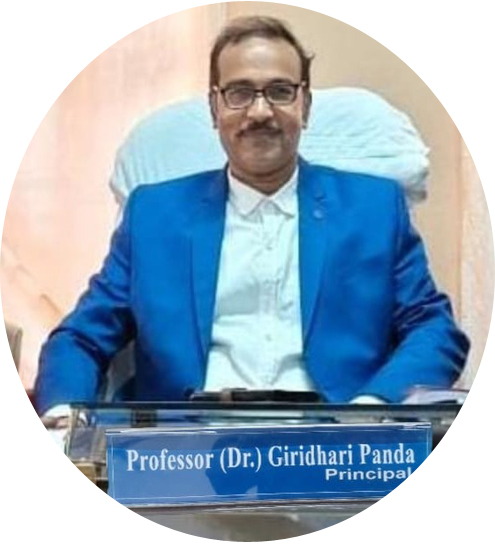
Professor (Dr.) Giridhari Panda
Principal
Bhatter College, Dantan (Autonomous)
Dantan, Paschim Medinipur